EcoSwitch: Why We Are the #1 Commercial & Residential Solar Company in Bihar (Serving All 38 Districts)
India stands at a critical juncture in its developmental journey. As one of the world's fastest-growing major economies, the country is witnessing a massive surge in urbanization, industrial production, and digital infrastructure. However, this economic engine requires an astronomical amount of power to keep running.
The traditional reliance on fossil fuels has brought India face-to-face with a dual crisis: severe environmental degradation and an economic strain caused by heavy energy import dependencies.
To achieve the vision of self-reliance under Viksit Bharat 2047, navigating away from volatile fossil fuels toward domestic, clean energy is no longer just a climate objective—it is a macroeconomic necessity. By scaling up solar and wind technology, India can effectively mitigate its energy crisis, secure its grid, and fuel its future sustainably.
1. The Anatomy of India's Current Energy Mix
To understand how solar and wind can resolve India's power vulnerabilities, we must first look at where the country's electricity currently comes from. Historically, India’s grid has been built on coal.
As of early 2026, the power sector’s asset baseline reveals a massive shift, though the operational generation mix still reflects a deep fossil-fuel footprint:
| Energy Source | Operational Attributes & Role in the Grid |
|---|---|
| Coal & Lignite | Remains the heavy-lifting baseline provider, accounting for roughly 55-60% of total actual electricity generation. |
| Solar Energy | The fastest-growing component, exceeding 150 GW of installed capacity by March 2026. |
| Wind Energy | Heavily deployed in coastal and gusty corridors, with capacity surpassing 56 GW. |
| Large Hydro & Nuclear | Provide foundational clean baseline support, with Hydro handling seasonal peak fluctuations. |
| Natural Gas & Diesel | Primarily used as expensive, fast-ramping options during critical peak shortages. |
Historically, fossil fuels met over 70% of India’s operational generation demand. However, a fundamental tipping point was reached recently. By mid-2025, India achieved the milestone of having 50% of its cumulative electric power installed capacity from non-fossil fuel sources, hitting its Paris Agreement Nationally Determined Contribution (NDC) target a full five years ahead of schedule. By March 2026, total non-fossil installed capacity scaled beyond 283 GW.
Yet, an "installed capacity" milestone does not mean the crisis is entirely resolved. Because solar and wind are variable resources—they only generate power when the sun shines or the wind blows—fossil fuels like coal still meet the bulk of the absolute hourly electricity consumption. When extreme heatwaves strike, the gap between variable clean power capacity and raw baseline demand exposes the fragility of the energy ecosystem.
2. The Scale of the Surge: Quantifying India's Energy Demand
India's energy demand is breaking historic records year after year. The combination of scorching summers, rising disposable incomes (leading to widespread air conditioner adoption), and round-the-clock manufacturing has pushed the national grid to its absolute limits.
In April 2026, India successfully met an all-time high peak electricity demand of 256.1 GW without widespread shortages. This shattered previous records, and experts project that peak demand will comfortably reach 270 GW before the end of the year.
[All-Time Peak Power Demand Met in India (2024-2026)]
2024 (May): 250.0 GW
2026 (Jan): 245.4 GW
2026 (Apr): 256.1 GW <-- All-time high
2026 (Proj): 270.0 GW
This rapid scaling means the country cannot simply rely on incremental capacity additions. Total annual power generation has reached over 1,845 Billion Units (BU). The critical challenge is that electricity consumption is growing at an annual rate of 8% to 9%. To prevent this massive demand from causing frequent blackouts, India must aggressively expand its power generation capabilities.
3. The Economic Drain: Import Dependencies and Geopolitical Vulnerability
The true core of India's energy crisis is not a lack of power lines; it is an economic drain. India imports the vast majority of the raw fuels used to power its transport and industrial sectors, making the economy highly vulnerable to global geopolitical shocks.
According to data from the Ministry of Statistics and Programme Implementation (MoSPI) for the 2025-2026 period, India’s import dependency for fossil fuels remains unsustainably high:
* Crude Oil: ~89.4% imported
* Natural Gas (LNG): ~49.7% imported
* Coal: ~23.5% imported (primarily high-grade coking coal for steel and specific power plants)
Where Does India Import Energy From?
To satisfy this demand, India relies on a complex global supply chain:
* Crude Oil & Petroleum: Predominantly sourced from Russia, Iraq, Saudi Arabia, and the UAE. Conflicts in West Asia routinely threaten shipping lanes and spike crude prices, causing domestic inflation.
* Liquefied Natural Gas (LNG): Sourced heavily from Qatar, the United States, and West African nations.
* Coal: Imported primarily from Indonesia, Australia, and South Africa.
When global events cause fossil fuel prices to spike, India spends billions of dollars in foreign exchange reserves just to keep its lights on and vehicles moving. This structural vulnerability highlights why transitioning to domestic solar and wind energy is vital for national security and economic stability.
4. Sector-Wise Breakdown: Where Will Future Demand Explode?
The next decade will see a major structural shift in how India consumes energy. While traditional residential lighting and agricultural water pumping remain important, three major sectors are poised to drive massive energy demand in the coming days.
Industrial Manufacturing & The "Green Steel" Shift
Under initiatives like "Make in India," heavy industries such as manufacturing, electronics, steel, and cement are expanding rapidly. Furthermore, global supply chains are demanding decarbonization. To remain competitive, Indian heavy industry must transition away from direct coal combustion to electricity and clean hydrogen fuels, placing a massive new burden on the electrical grid.
The Electric Vehicle (EV) Revolution
The electrification of transport is accelerating across India. States like Kerala and Karnataka are already seeing EV adoption rates hover around 9% to 10.5% of all new vehicle registrations. As millions of two-wheelers, three-wheelers, public buses, and passenger cars plug into the grid over the coming years, they will require massive amounts of daytime and nighttime power. If these vehicles are charged using coal-fired power plants, the environmental benefits are lost; they must be powered by clean energy.
Data Centers and the AI Boom
India's digital economy is expanding rapidly. The massive growth of fintech, e-commerce, and artificial intelligence has created an unprecedented need for data centers. Data centers operate 24/7/365 and require enormous amounts of uninterrupted cooling and computational power. Global tech giants managing these facilities have strict corporate mandates to run on 100% renewable energy, creating a direct, high-volume market for green power.
5. Harnessing Solar and Wind to Overcome the Crisis
Solar and wind technologies are uniquely positioned to solve India's energy dilemma. Rather than importing expensive fuels across volatile oceans, India can harvest abundant natural resources within its own borders.
[THE HYBRID RENEWABLE ECOSYSTEM]
Solar PV Array Wind Turbine Farm
(Peak: Midday/Summer) (Peak: Evenings/Monsoon)
│ │
└───────────────────┬──────────────────────┘
▼
Smart Grid Infrastructure
┌───────────────────┴──────────────────────┐
▼ ▼
Battery Storage (BESS) Direct End-Users
(Dispatches during night peak) (Industry, EVs, Data Centers)
The Complementary Nature of Solar and Wind
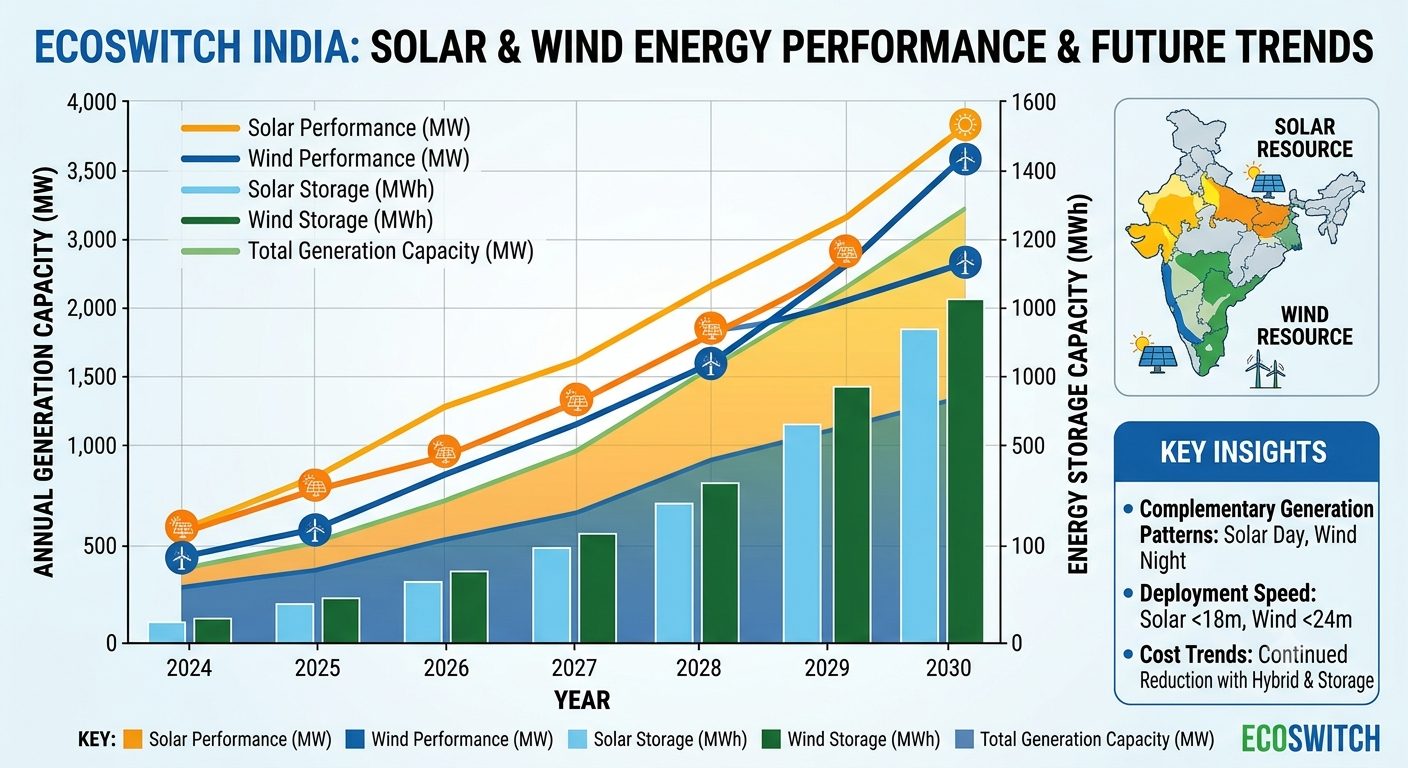
One of the greatest challenges of renewable energy is intermittency—solar disappears at night, and wind can be unpredictable. However, in India, these two resources complement each other exceptionally well:
* Solar PV reaches peak generation during midday hours (10:00 AM to 3:00 PM), perfectly matching the massive power demand created by commercial offices and afternoon air conditioning loads.
* Wind Energy typically surges during the late evening hours, throughout the night, and during the annual monsoon season when solar generation drops due to cloud cover.
By co-locating wind turbines and solar panels under the National Wind-Solar Hybrid Policy, developers can utilize the same transmission lines and land plots. This hybrid approach provides a far more stable, consistent output to the grid than either technology could manage alone.
Distributed Energy and Rural Resilience
Large, centralized coal plants require billions of dollars in transmission infrastructure to send electricity to remote villages. Solar flips this model entirely.
Through decentralized applications like rooftop solar and the PM-KUSUM scheme, India is solarizing millions of agricultural water pumps. In the 2025–26 fiscal year alone, over 13.9 lakh agricultural pumps were solarized. This initiative removes farmers from the traditional grid, saves billions of liters of diesel, reduces agricultural subsidies, and ensures reliable daytime power for irrigation.
6. Key Bottlenecks: What Stands in the Way?
Despite this incredible momentum, transitioning to a renewable-led grid involves significant structural challenges. India must overcome three primary roadblocks to fully realize this clean energy transition:
* Grid Flexibility and Transmission Gaps: The transmission corridors connecting high-resource states (like Rajasthan and Gujarat) to industrial hubs are becoming congested. Without a robust network to move power across state lines, clean energy risks being wasted.
* The Storage Imperative: To completely replace coal as a baseline energy source, India needs large-scale energy storage to manage evening peak demands. While Battery Energy Storage Systems (BESS) and Pumped Hydro Storage (PSP) are becoming more affordable, they require massive deployment to secure the grid.
* Geographic Concentration: As of 2026, nearly 66% of India's non-fossil capacity is concentrated in just five states: Rajasthan, Gujarat, Maharashtra, Tamil Nadu, and Karnataka. To reach the national goal of 500 GW by 2030, other states must modernize their regulatory frameworks and rapidly accelerate their clean energy procurement.
7. The Road to 2030 and Beyond
India's strategy to resolve its energy crisis relies heavily on its updated Nationally Determined Contribution (NDC 3.0) and the ambitious goal of reaching 500 GW of non-fossil fuel capacity by 2030.
To achieve this, the country is executing a comprehensive roadmap:
* Massive Infrastructure Investments: The Union Budget has substantially increased funding for the Green Energy Corridor and the Revamped Distribution Sector Scheme (RDSS), focusing on smart grids, upgraded substations, and interstate transmission lines.
* Domestic Manufacturing (Atmanirbhar Bharat): To avoid replacing a dependence on imported oil with a dependence on imported solar components, India has scaled its domestic solar module manufacturing capacity to over 172 GW as of 2026, largely driven by the Production Linked Incentive (PLI) scheme.
* Exploring Offshore Wind: With a vast 7,500-kilometer coastline, India is moving beyond onshore wind projects to tap into deep-sea offshore wind potentials along the coasts of Gujarat and Tamil Nadu.
Conclusion
The energy crisis in India is ultimately a challenge of growth. As the nation builds its future, relying on volatile, imported fossil fuels is no longer a viable path forward. Fortunately, the solution lies directly overhead and along the country's windy coastlines.
By combining solar and wind energy with modern grid infrastructure, domestic manufacturing, and advanced battery storage, India can build a highly resilient energy ecosystem. This transition will help the country reduce its massive import bills, shield its economy from geopolitical disruptions, and provide clean, reliable power to every citizen. The ongoing shift toward renewable energy is rewriting India's developmental narrative, ensuring that its economic growth is both sustainable and entirely self-reliant.
For a deeper dive into the policy mechanics and real-world execution behind these targets, you can watch this insightful discussion with India's Renewable Energy Minister on achieving the 2030 goals. This video details the concrete steps and public-private partnerships driving India's rapid clean energy expansion.